12 kW vs 15 kW vs 20 kW vs 30 kW Fiber Laser: How to Choose
PCL Fiber Laser Guide · Flat Plate Cutting
Choosing a high-power fiber laser is not simply a matter of buying the largest kilowatt rating available. The right configuration depends on your materials, regular plate thicknesses, edge-quality requirements, production volume, machine format and factory utilities.
This guide focuses on the 12–30 kW range for flat-plate cutting. Compare complete, tested configurations—not power ratings in isolation.
Quick Answer: How Do You Choose Between 12 kW and 30 kW?
Start with the jobs you need to produce consistently—not the maximum thickness a machine might cut once. A 12 kW system may suit many plate-cutting applications. Higher power is worth evaluating when your regular workload, target cycle time or material range justifies it.
Ask the supplier to test your actual material grade, thickness and part geometry. Compare finished edges, cycle time and process conditions. A headline speed or maximum-thickness figure alone cannot predict production results.
If you are comparing 1.5 kW, 2 kW, 3 kW and 6 kW systems, see our guide to choosing fiber laser power for general sheet-metal work.
12 kW, 15 kW, 20 kW and 30 kW: A Practical Comparison
This is a selection framework, not a promise of speed or cutting thickness. Results depend on the source, cutting head, material, gas, nozzle, machine setup and required edge quality.
Specification note: PCL’s published gantry laser page lists power options from 1 kW to 30 kW. Public continuous-production reference data include specific figures for 12 kW and 15 kW. Confirm current availability and test results for your exact configuration before purchase.
| Power | What to compare | Questions for the supplier |
|---|---|---|
| 12 kW | Reference results for your common materials and thicknesses. | Does the sample meet your edge-quality and output targets? Which gas, nozzle and head were used? |
| 15 kW | Measured cycle-time and quality difference versus 12 kW on identical parts. | Which regular jobs benefit from the upgrade? What is the measured cycle-time improvement? |
| 20 kW | System availability, utilities and validated performance for your workload. | Can the supplier demonstrate your material and thickness on the proposed configuration? |
| 30 kW | Complete machine and facility requirements—not only the source rating. | What is included in the quote, and which cutting data have been verified? |
12 kW
Evaluate as a production baseline
PCL publishes continuous-production reference figures for carbon steel and stainless steel at this power. Verify the process with your material and quality requirements.
15 kW
Measure the real upgrade
Compare a 15 kW test with the 12 kW result on the same parts. Do not assume the higher rating delivers a proportional output increase.
20 kW
Check the production case
Define material mix, utilization and infrastructure first. Ask the supplier to confirm the proposed source, cutting head and tested process.
30 kW
Assess the full system
Review the bed, motion system, cooling, gas supply, extraction and electrical requirements alongside the source and cutting results.
Published reference: PCL’s gantry laser page lists up to 35 mm carbon steel and 25 mm stainless steel as 12 kW continuous-production reference thicknesses, based on the stated source data. These are not guaranteed results for every material grade, machine setup or edge-quality requirement. Confirm current data and request a sample test.
For material, gas and thickness references, see the fiber laser cutting speed chart. Treat chart values as a starting point for testing, not a substitute for a production trial.
When Does a Higher-Power Fiber Laser Make Sense?
A higher-power system may be worth evaluating when your production records show a clear need: you regularly process thicker plate, have a defined throughput target, or want one system to handle a wider mix of jobs.
It may be harder to justify when most work is thin sheet, utilization is low, or loading and unloading—not cutting—is the production bottleneck. Estimate usable cutting hours per shift, including setup, material handling, part sorting, nozzle changes and maintenance.
- List the material grades and thicknesses you run each week.
- Separate regular production from occasional maximum-thickness jobs.
- Record parts per shift and current bottlenecks.
- Compare measured cycle time and finished quality at each proposed power.
- Estimate added utility and operating requirements before choosing a higher rating.
Do Not Compare Machines by Kilowatts Alone
Two machines with the same nominal power can produce different results. Compare the complete configuration and ask the supplier to list exactly what is included.
Laser source and cutting head
Confirm make, model, rated power, warranty, service arrangements, head rating, focus control and consumable availability.
Bed and motion system
Match the working area and machine structure to your plate size, loading method, positioning needs and factory layout.
CNC, nesting and workflow
Check drawing formats, nesting workflow, software licensing, operator training and integration requirements.
Utilities and after-sales
Request written requirements for power, cooling, gas and extraction. Clarify commissioning, training, spare parts and service response.
Why Machine Format Matters for High-Power Plate Cutting
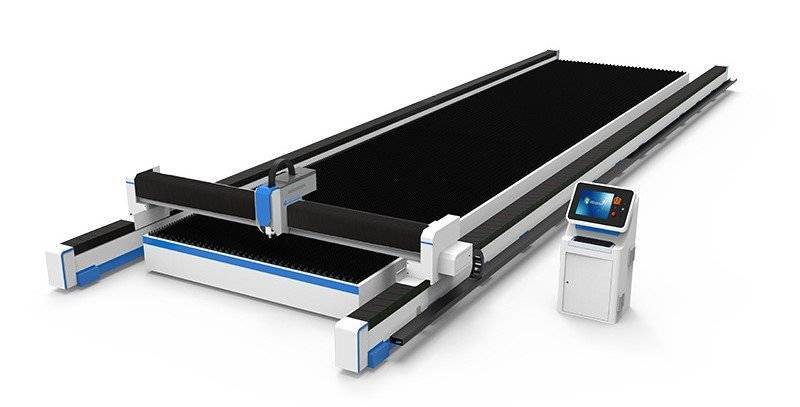
Laser power and work area are separate decisions. If your parts fit standard sheet sizes, an enclosed sheet laser with an exchange table may be suitable. If you regularly process long plates or full mill plates, a gantry machine with a longer bed may reduce repositioning and part-splitting.
PCL’s published gantry fiber laser page lists working lengths up to 12,000 mm and plate formats such as 3 × 8 m and 3 × 12 m, with other sizes to order. The page lists power from 1 kW to 30 kW. Confirm the exact bed, source, power and options in the quotation; do not assume every combination is standard.
A Fair High-Power Cutting Test: What to Send the Supplier
A useful test should reproduce your production job as closely as possible. Prepare:
- Material grade, thickness and material standard, if known.
- Maximum plate dimensions and required machine working area.
- DXF or other drawings for representative parts.
- Required edge condition, dimensional tolerance and downstream welding or coating needs.
- Expected parts per shift, shifts per day and estimated annual operating hours.
- Preferred assist gas and any facility or utility limits.
Ask the supplier to record source power, cutting head, nozzle, gas type and pressure, focus, speed, pierce settings and material condition. Request finished samples so your team can inspect the result.
Estimate Total Cost, Not Just the Machine Price
The purchase price is only one part of the decision. Compare the machine, source, cutting head, chiller, extraction, automation, installation, training, freight and facility work. Operating costs can include electricity, assist gas, consumables, maintenance and downtime.
After shortlisting a power range, review our guide to fiber laser cutting machine prices and the factors that affect a quotation. Ask for the included configuration and options to be itemized.
Frequently Asked Questions
Is a 30 kW fiber laser always faster than a 12 kW machine?
No. The result depends on material, thickness, part geometry, cutting process and machine configuration. Compare a measured test on your own parts rather than assuming output scales directly with rated power.
What thickness can a 12 kW fiber laser cut?
There is no single figure for every machine and material. PCL’s published gantry page lists up to 35 mm carbon steel and 25 mm stainless steel as continuous-production reference values for 12 kW. Confirm material grade, edge requirement, gas and process settings with a sample test.
Should I choose 20 kW or 30 kW for thick plate?
Base the choice on regular production and validated cutting results, not occasional maximum-thickness claims. Test your thickest recurring material and the materials that account for most production hours.
Does higher laser power require a larger machine bed?
No. Power and working area are separate configuration choices. Select a bed that fits your plate sizes and handling process, then confirm which power and bed combinations are available.
Can a 12 kW or higher fiber laser cut stainless steel?
Fiber lasers are used for stainless-steel sheet and plate, but results depend on thickness, assist gas, source, cutting head and process settings. Define the required edge finish and test the actual grade and thickness.
Does PCL offer 40 kW or 60 kW configurations?
PCL’s published gantry laser page currently lists power from 1 kW to 30 kW. If your project requires 40 kW or 60 kW, contact PCL to confirm current availability and the complete configuration before including those ratings in a purchase specification.
Technical values are configuration-dependent. Confirm current specifications and validate production requirements with a material test before ordering.
Buy from the factory. PCL Group has built machines in Jinan since 2006. Some resellers use our photos and videos for other machines. Genuine quotes come from info@laser-solution.com or +86 186 6017 4681.