2 m Reach Welding Robots for MAG Welding: Five Models Compared
PCL Group application engineering, Jinan · Updated 20 October 2026
For MAG welding of structural steel, the robot arm most cells are built around is a six-axis arc welding robot with roughly 2 m of reach. It is long enough to cover a beam-and-plate assembly from one position and light enough to sit on a track or hang from a gantry. Below are five arms in that class and, more usefully, the questions that decide whether a robot will actually weld your parts well.
Five arms in the 2 m class
Reach figures follow the model designations. Payload, repeatability and wrist options change between variants and generations, so take the current datasheet from the manufacturer before laying out a cell.
| Robot | Reach | Worth knowing |
|---|---|---|
| Yaskawa Motoman AR2010 | About 2,010 mm | Arc welding series; torch cable routed through the arm |
| KUKA KR 8 R2100 arc HW | About 2,100 mm | “HW” is the hollow wrist that carries the torch package |
| ABB IRB 2600ID-8/2.00 | About 2.0 m | “ID” means integrated dress: hoses inside the upper arm |
| FANUC ARC Mate 120iD, long-arm variants | Up to about 2 m, by variant | Hollow wrist welding arm; pick the variant for your reach |
| Panasonic TM-2000 (TAWERS) | About 2 m | Robot and welding power source designed and controlled as one system |
All five are proven welding arms with large installed bases. Between them, the deciding factors are rarely on the datasheet: the welding power source you want, local service, and what the integrator knows best.
Reach on a real part
Catalogue reach is measured to the wrist, from the centre of the base, at the best angle. Your torch adds length but must also be held at a sensible angle to the joint, which costs reach. A useful rule is to check the furthest seam with the torch at its working angle, not just whether the wrist gets there.
On H-beams the awkward welds are inside the flanges: stiffeners, end plates and gussets near the web. A 1,000 mm deep beam with wide flanges leaves a narrow box to reach into, and the wrist and torch body must fit as well as the torch tip. Draw your deepest section with the torch in place before choosing the arm.
Floor, track or gantry
| Mounting | Suits | Watch out for |
|---|---|---|
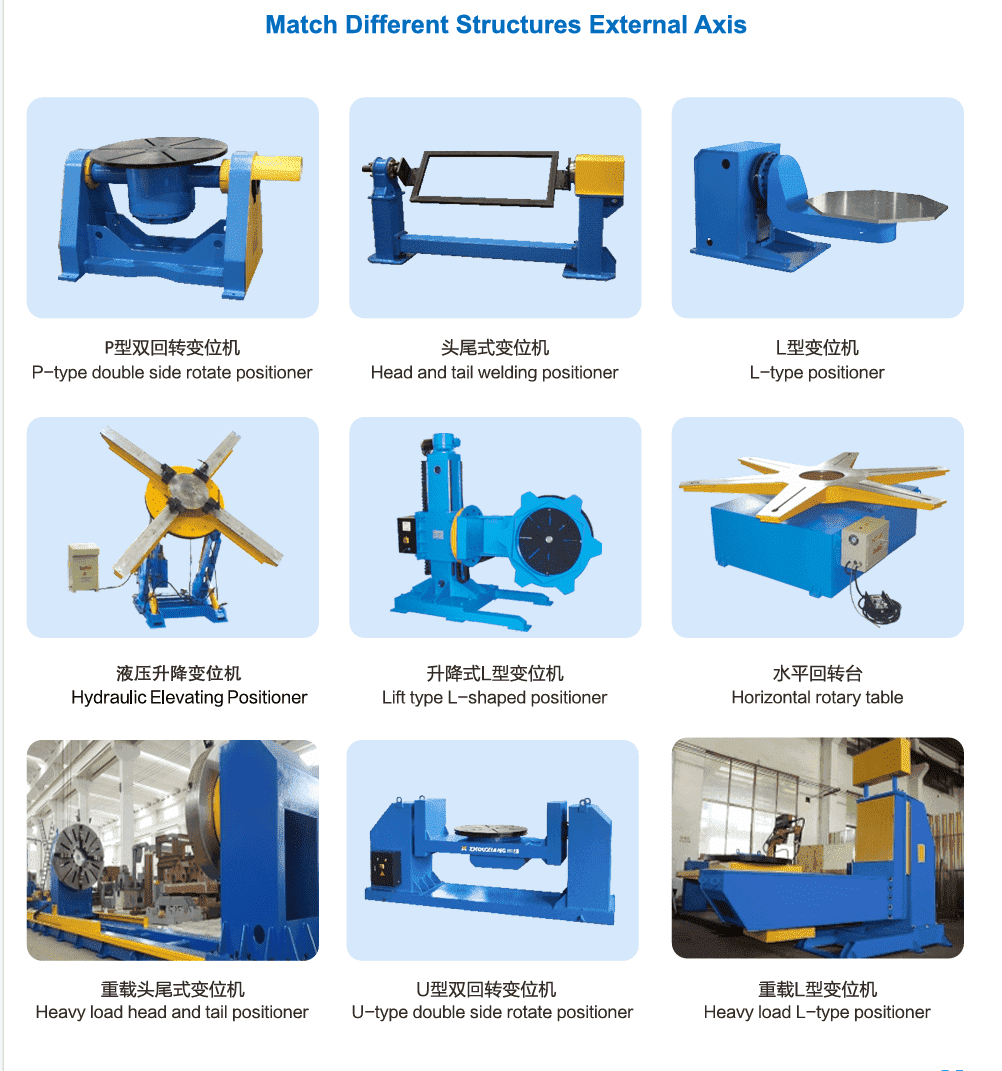
| Floor, fixed | Small assemblies on a positioner | Parts must come to the robot |
| Linear track (7th axis) | Beams up to the track length | Floor space along the full beam |
| Inverted on a gantry | Long beams and large frames; one or two robots | Gantry stiffness and height |
| With a positioner | Turning the part for flat-position welds | Part weight and fixturing |
For long beams, the track or gantry usually matters more than the last 100 mm of arm reach. A gantry with two inverted robots can weld both sides of a beam at the same time, which also helps keep distortion symmetrical.
Finding the seam
Structural parts are never exactly where the program expects them. Fit-up gaps vary, plates sit a few millimetres off, and beams are not straight. The robot has to find the real joint:
Touch sensing
The wire touches the plates to locate the joint before welding. Cheap and reliable, but each search takes a few seconds, which adds up on parts with many short welds.
Arc seam tracking
The robot weaves and reads the change in welding current to stay centred during the weld. Good for long fillets; needs a weave.
Laser seam sensor
A laser line ahead of the torch measures the joint as the robot moves. Fast and accurate, adds cost and payload, and needs clean surfaces.
Vision scan before welding
The whole part is scanned and paths are generated from the scan. This is how teaching-free stations work.
Multi-pass and thick welds
Structural work means large fillets and full-penetration groove welds that take several passes. Check how the controller handles multi-layer welding: the root pass is taught or generated, and later passes are offset from it. Ask to see a multi-pass weld on a joint like yours, and check heat input and interpass temperature against your welding procedure.
Choosing the power source
Some robots are built around their maker’s own power source; others take several brands through a digital interface. Pulsed MAG gives lower spatter and better control on thin-to-medium plate, while spray transfer is used on thick multi-pass joints. Decide what processes you need, then check that the robot and power source communicate fully: wire feed, voltage, arc start and crater fill all from the robot program.
From cutting to robotic welding
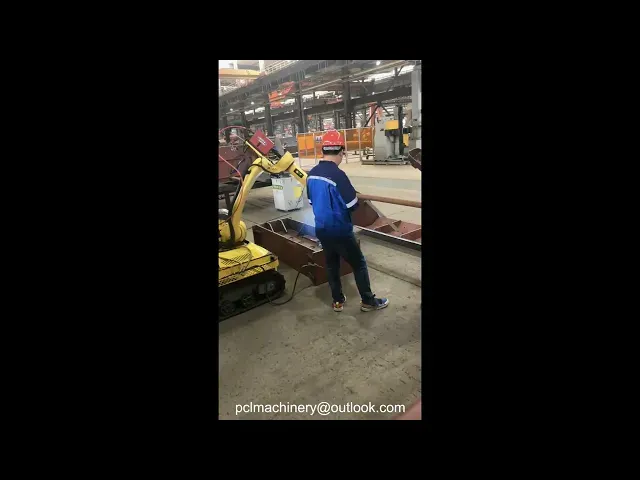
Video: beams cut on the H-beam laser go straight to a PCL robotic welding cell. Accurate cutting is what makes automatic welding work.
What to send a supplier
PCL designs complete cells for structural steel: robotic welding stations, gantry welding systems for long beams, and teaching-free stations that weld from a scan or a Tekla model. For how robots are programmed, see drag teaching, pendant and teaching-free compared.
Common questions
Which welding robots have about 2 m reach?
Common examples are the Yaskawa Motoman AR2010, KUKA KR 8 R2100 arc HW, ABB IRB 2600ID-8/2.00, long-arm variants of the FANUC ARC Mate 120iD and the Panasonic TM-2000. Check current datasheets for exact figures.
Is 2 m reach enough for H-beam welding?
For stiffeners and end plates on most beams, yes, if the robot runs on a track or gantry along the beam. Check the deepest section with the torch at its working angle.
Touch sensing or laser seam tracking?
Touch sensing is cheaper and reliable but slower on parts with many short welds. Laser sensors are faster and more accurate but add cost and need clean surfaces.
Can one gantry carry two robots?
Yes. Two inverted robots on one gantry can weld both sides of a beam at once, which saves time and keeps distortion balanced.